Author | André Jordaan, Partner Consultant, Pragma
MRO inventory differs from other inventory classes because demand is irregular, the consequences of stockouts are often far greater, criticality matters more than usage velocity, and repairable items and obsolescence add complexity that traditional inventory models do not handle well.
Most businesses do not lose uptime because they do not own spare parts. They lose uptime because they do not own the right spare parts.
Stores can be packed with items while availability remains poor, and the debate quickly turns into a tug-of-war between Finance and Operations over what “optimal” really means.
Maintenance, Repair and Operations (MRO) goods are often grouped under “inventory” as if they behave like raw materials, work-in-progress, or finished goods. In reality, MRO inventory is a different class altogether: it supports production, but it is typically not part of the final product, which changes how demand forms, how risk should be managed, and how success should be measured.
When done correctly, spare parts programmes typically reduce inventory by 10–30% while maintaining or improving spare part service levels, precisely because optimisation becomes consequence-driven, not blanket cost-cutting.
What is MRO inventory?
MRO inventory refers to maintenance, repair and operations goods used to support production and asset uptime, but not typically incorporated into the final product.
Let us first unpack the classification of inventory on the functional level.
- Raw Material
- Work-in-progress (WIP)
- Finished Goods
- Packaging Material
- MRO Goods (Maintenance, repair and operating supplies)
MRO goods include goods used for:
- Maintenance: Items for scheduled maintenance such as lubricants and filters
- Repairs: Spare parts required to fix machinery such as gears, bearings and fasteners
- Operations: Operating supplies that are part of the production process, but not part of the final product, such as adhesives, office materials, PPE, cleaning materials and tools
How is MRO similar to other inventory classes?
MRO goods are grouped under inventory, and it is easy to see why. They share a significant number of similarities.
- They tie up capital. They cost the organisation money, trap working capital and need to be minimised or optimised.
- They need to be managed. Like all inventory classes, they depend on item master data, stock accuracy, reorder parameters, physical storage and handling discipline.
- They are exposed to supply chain risk. Supplier lead time variability, vendor dependency and price volatility all affect MRO just as they do other inventory categories.
These similarities, especially the fact that they tie up capital, often lead procurement or finance to take responsibility for MRO spares with the intention of optimising them. This is usually where the real challenge starts, because the differences are much more important than they first appear.
What makes MRO inventory different?
The following differences in MRO inventory are typically observed.
1. MRO goods do not directly generate revenue. Because they do not form part of the production process output, they do not directly generate income. They do, however, enable the generation of revenue by protecting uptime and execution.
2. Demand is irregular. Demand depends on services and failures, which makes it appear unpredictable. To the engineer, understanding what drives demand makes it less irregular, since services are predictable, leaving mainly failures as uncertain. Even failures can be better understood over time. That demand profile makes traditional smooth forecasting and replenishment rules fragile when the demand drivers are not properly understood.
3. Demand is very small. MRO stores generally hold a large proportion of items with demand of less than once a year. This is generally 40–80%. This makes standard procurement optimisation models ineffective or meaningless.
4. Stockouts have asymmetric consequences. For most inventory categories, a stockout means a lost sale or delayed delivery. An MRO stockout might not always stop production, but when it does, the effect can be severe. There is often no correlation between the value of the part and the cost of its non-availability. The unavailability of a bearing can cause millions in production losses.
5. Criticality matters more than velocity. In retail-style inventory, fast movers grab the attention. In MRO, the critical spare that hardly moves may be far more important because of the consequences of a stockout. The danger is that MRO criticality is often judged by usage rather than by consequence, even though consequence is most often the true driver.
6 Repairable items or rotables create a second supply chain. Some spares rotate through a cycle of in service, removed, repaired, returned to stock and back to service. This introduces repair lead times, scrap rates and turnaround stock decisions that do not exist in typical buy, consume and reorder logic.
7. Master data is more complex. MRO spares often involve thousands of skew items. Repair items must be aligned to bills of material on the asset or equipment side. Each needs to be described and codified so that duplicates can be recognised, removed or managed as interchangeable items. This is more complex and more labour-intensive than with most other inventory classes, and it is critical for MRO service levels and performance.
8. Obsolescence risk is higher. Changes in equipment, technology and production requirements increase the risk of obsolescence. This risk is greater for MRO goods because they are often stored for long periods.
Why does MRO inventory matter?
The key points to come out of these differences are simple.
- The demand profile and intent behind MRO goods are very different from those of other inventory categories.
- The consequence of a stockout is also vastly different.
These two factors alone render traditional supply chain inventory optimisation techniques inappropriate and often almost useless for MRO, because they do not cater for slow-moving and non-moving inventory, which constitutes 40–80% of the stock profile, and they do not consider the consequences of a stockout.
This can be seen from plotting the typical inventory optimisation methodology over the underlying inventory:
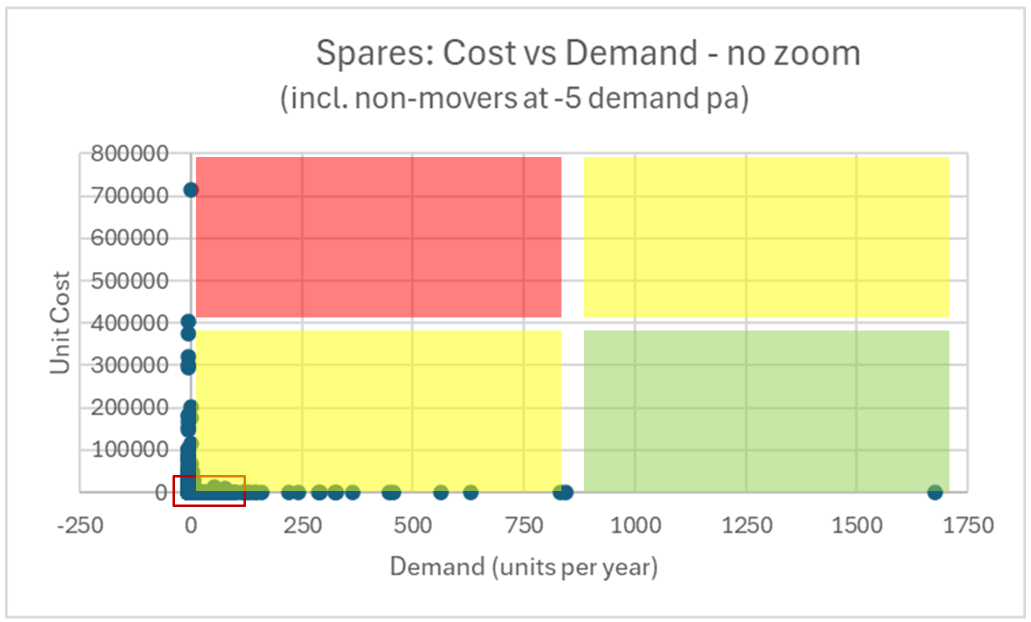
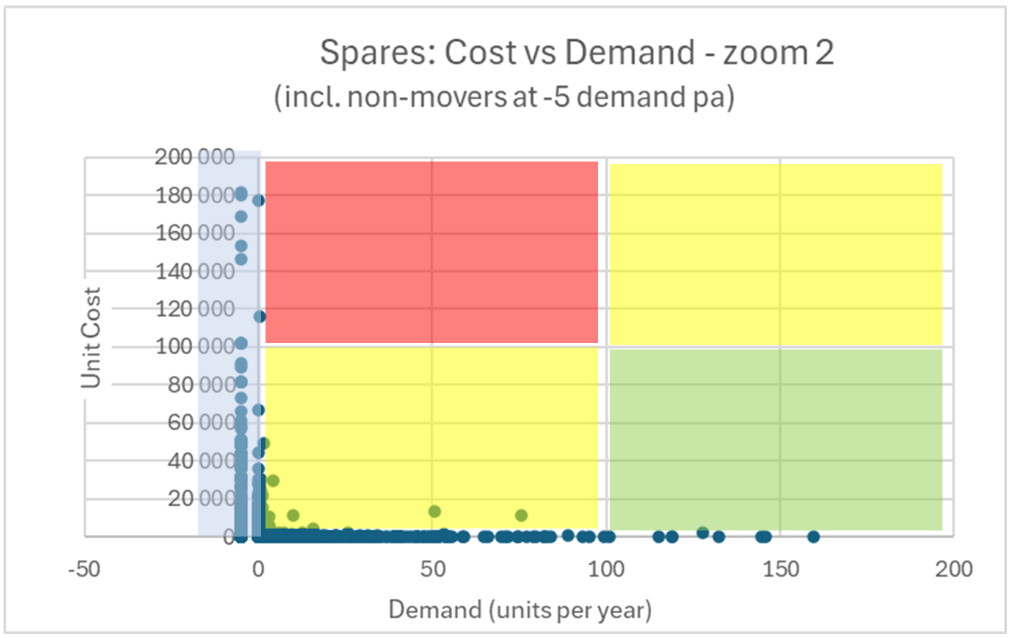
Even when zoomed in, the traditional procurement model is still an obvious misfit to the data at hand.
Traditional procurement optimisation methodologies work on the fast-moving consumable type of inventory, but this typically accounts for only 10–20% of MRO inventory. To truly optimise the MRO world, one needs to consider all MRO goods.
In practical terms, this matters because:
- traditional forecasting works poorly on slow and irregular demand
- the cost of a stockout can far exceed the cost of the item
- criticality is often a better decision driver than movement
- standard procurement KPIs can mislead MRO decisions
Why do traditional inventory optimisation methods fail for MRO?
Traditional procurement optimisation methodologies are designed for faster-moving, more predictable demand profiles. They assume that usage history is a reliable guide to future needs and that item value can help steer decision-making.
That logic breaks down in MRO.
They do not cater properly for slow-moving and non-moving inventory, which makes up a large share of MRO stock. They also do not account for the operational and financial consequences of a stockout. A low-cost part with high consequence will often be underappreciated in traditional models.
This is why traditional inventory logic may work reasonably well for raw materials or finished goods, but becomes an obvious misfit when applied to MRO spares.
What KPIs matter for MRO inventory?
Since the intent of MRO spares is not to generate throughput but to provide what is required when it is required, typical inventory KPIs can become irrelevant.
KPIs like turnover rate cannot be the primary drivers. Even a KPI like consolidation ratio becomes irrelevant for many of the spares that move too slowly to make consolidation meaningful.
Measures need to adapt. The ultimate lagging indicator becomes service level against what is optimal, while also reducing stock on hand and optimising stock replenishment frequency.
How to overcome the obstacles
To optimise MRO spares, the consequences of a stockout must be understood, and the optimal replenishment quantity must be calculated. Understanding the consequences of a stockout is not easy, because factors such as buffers, alternative strategies, lead times and the interchangeability of spares all need to be considered.
Measures also need to adapt. The ultimate lagging indicator now becomes the “service level against what is optimal”, while reducing the stock on hand and optimising the stock replenishment frequency.
Where should you start with MRO inventory optimisation?
One shared view of MRO: Aligning Reliability, Supply Chain, Finance and Operations
MRO inventory differs because it exists not only to support operations, but also to protect them from uncertainty. This can only happen when multiple disciplines manage it from the same consequence-driven angle.
When Maintenance and Reliability align spares to the consequence of a stockout, planned work executes without “waiting for parts” firefighting.
When Stores and Supply Chain apply disciplined processes, clean master data and compliant store practices, the right items are ordered in the right quantities and are available when needed.
When Finance understands that service levels are based on the optimal point between the cost of holding spares and the cost of a stockout, working capital can be released without quietly increasing operational risk.
And when Operations can trust that spares will support execution, throughput becomes more stable.
All of this depends on everybody agreeing on a single source of truth, a model that can optimise the whole of MRO inventory and not just the 10–20% of fast-moving consumables. To do this, one needs a solution that understands the consequences of a stockout and can model them within the optimisation framework.
There may well be other shortcomings in the spares environment that also need attention. But this is not either/or. It is both and more. It does not help to improve ordering discipline if the model itself is wrong.
Once the model has been optimised, the measures need to adapt to tracking service level against the optimised plan and measuring process compliance.
Conclusion: MRO spares must be managed differently
MRO spares look like inventory on paper but behave like risk mitigation in practice.
They must be managed less like products and more like protection for operational continuity. Applying production inventory logic to MRO spares is one of the most common and costly mistakes in asset-intensive organisations.
The consequence of MRO spares must be understood and incorporated into the optimisation model if stock levels are to be truly optimised. Thankfully, such solutions and methodologies now exist.
To learn more about this approach, please contact us.
Frequently asked questions about MRO inventory
What is MRO inventory?
MRO inventory refers to maintenance, repair and operations goods used to support production and asset uptime, but not typically incorporated into the final product.
Why is MRO inventory different from raw materials and finished goods?
MRO inventory supports production rather than becoming part of the final product. Its demand is often irregular, its stockouts can have severe operational consequences, and its management depends more on criticality and risk than on demand velocity.
Why do traditional inventory models fail for MRO spares?
Traditional inventory models are built around smoother, faster-moving demand and often assume that stockout consequences are closely related to item value. MRO spares do not behave this way, especially where slow movers, critical parts, and repairables are involved.
What is the biggest risk in understocking MRO spares?
The biggest risk is not simply a missing part, but the operational and financial consequence that follows. A low-cost spare part can trigger major downtime losses if it is not available when needed.
What should MRO inventory optimisation measure?
MRO inventory optimisation should measure service level against what is optimal, while also considering stock on hand, replenishment frequency, and the consequences of a stockout.