Most organisations don’t choose their work order feedback culture. They drift into it. A new compliance push arrives, and the close-out screen grows by ten fields. A reliability engineer asks for better failure history, and another ten appear. Someone wants cleaner KPI reporting, but more fields keep getting bolted on “because we might need them later”.
A year later, you have the worst of both worlds: artisans rush the admin so they can get back to physical work, the captured information becomes inconsistent, and managers no longer trust the history. When that happens, feedback stops being an asset management tool and becomes an argument generator.
The core insight is simple: work order feedback isn’t a form. It’s a design choice. Decide what you need it for, then design the loop so it’s easy enough to do properly.
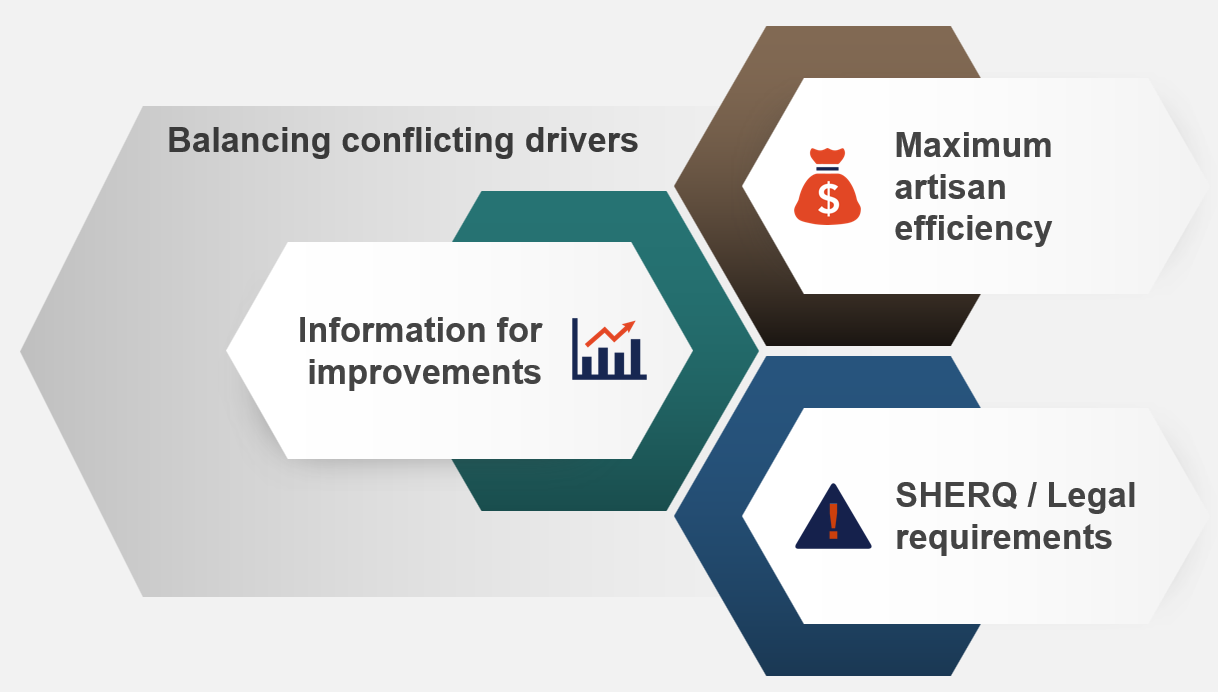
Why work order feedback is a real balancing act (not a ‘discipline problem’)
Engineering managers and legally appointed engineers operate at the point where these priorities converge:
- they need defensible compliance evidence,
- they need usable history for improvement, and
- they need to protect artisan efficiency (because admin is not why you employ artisans).
That tension is not theoretical. Wrench time is typically a minority of the shift; industry articles summarising “national studies” often put it between 25–50%.1 That’s why every additional close-out requirement needs to earn its place. When you add fields that nobody uses, you don’t get “data”—you get friction.
The real problem is this: when work order data quality is poor, it doesn’t just reduce learning; it distorts measurement. NIST’s work on maintenance work order analysis shows that missing or inconsistent fields materially affect KPI calculations and trend insights, and that your analysis goal should dictate what “good data” even means.2
So, the practical question isn’t “How do we force better close-out?” It’s: What is the smallest amount of feedback we can capture that still protects the business and improves future work?
Design work order feedback by purpose, not fields
Different roles use the same work order history for different decisions: compliance sign-off, maintenance work management control, cost drivers, and reliability learning. If you try to satisfy everyone with one “perfect” close-out, you usually satisfy nobody.
A simple decision rule works well in practice: If you can’t name the user and the decision it supports, don’t capture the field. Once purpose drives the design, you can keep feedback lean while still building history you can trust.
In practice, work order feedback typically serves a small set of recurring purposes: proving statutory compliance, triggering follow-on work, improving tactics and master data, enabling root cause analysis, supporting reliability studies, and enabling maintenance management KPIs.
Minimum viable work order feedback isn’t a compromise; it’s sustainable
The fastest way to degrade the quality of feedback is to request information that will not be used. When people experience feedback as “paperwork that disappears,” quality collapses. A sustainable approach is to pick two or three purposes that matter most right now (based on risk profile and maturity), then define the minimum required fields and owners.
For example:
- If risk and statutory exposure are high, your minimum set must support evidence that work was physically done and defects were identified, corrected, or formally escalated, not just “completed on paper”.
- If inspections are your main tactic, your minimum set must reliably convert findings into follow-on work; otherwise, inspections consume scarce artisanal capacity without consistently reducing risk.
- If reliability is the goal, you need a small, consistent set that supports defect elimination and reliability analysis without burying the artisan in coding that no one reviews.
If you don’t close the loop … you’re just collecting paperwork
The value only becomes visible when feedback is closed, not just captured. That means the workflow must make it obvious:
- who reviews,
- who approves,
- who updates the job plans / master data, and
- how learnings get applied back into planning standards.
If the loop isn’t designed and owned, feedback becomes a black hole, and quality collapses.
This is also why “keep it simple” matters. As Tim Beavon (Pragma Partner Consultant) puts it in his rules-based thinking, when you complicate rules and processes too much, people stop following them.3
AMIP 5: The maturity backbone behind feedback disciplines
AMIP 5 frames Maintenance Work Management as an end-to-end capability—identify, plan, schedule, execute, and feedback, so weak feedback isn’t a reporting gap; it’s a maturity gap.
AMIP 5 launch insights also highlight a decade-long decline in Maintenance Work Management maturity and related performance outcomes, exactly the environment where feedback quality is often among the first to collapse.4
If you’d like the full practical guide, download the white paper: Extracting the Business Value from Maintenance Work Order Feedback.
References