AI is giving maintenance teams new ways to extract, structure and interpret information. But the value does not start with the model. It starts with the maintenance decision the organisation is trying to improve.
Maintenance organisations are exploring predictive models, intelligent assistants, automated analysis and agent-based workflows. A specific focus area is often the computerised maintenance management system (CMMS). The potential is significant, but the starting point is often misunderstood.
AI does not automatically understand an organisation’s assets and maintenance requirements. It works with the information available to it, including asset records, maintenance plans, work orders, failure histories, equipment documentation and technician feedback.
The practical question is therefore not simply where we can apply AI in the CMMS, but a more appropriate question is:
Which maintenance decision do we want to improve, and does our CMMS contain the information needed to support that decision?
The second part of this question matters. AI can reduce the effort required to extract, structure, compare, and analyse maintenance information, but it offers limited compensation for missing standards, unreliable records, weak maintenance processes, or unclear ownership.
To answer this question properly, we need to distinguish between a system of record containing information and a system of action that enables improvement actions based on that information.
A CMMS must be both a system of record and a system of action
Most maintenance organisations already use a computerised maintenance management system (CMMS). These systems usually support core activities such as:
- maintaining the asset register;
- managing maintenance plans;
- creating and scheduling work orders;
- recording labour, materials and costs;
- capturing execution feedback;
- reporting maintenance performance.
Together, these functions create maintenance records or database entries. Those records are essential but are not the final outcome. This is the system of record.
Maintenance value is created when the organisation uses the records to make decisions, typically in support of improvements. This could mean changing:
- a maintenance task or frequency;
- an asset criticality rating;
- a spare parts policy;
- a planning rule;
- a contractor requirement;
- an operating procedure;
- an equipment configuration;
- or a design standard.
As an example, completing a work order closes a maintenance task and creates a maintenance record, but it does not necessarily close the continuous improvement loop.
A CMMS must therefore function as both a system of record and a system of action. The system of record captures what assets exist, what work was planned, what was performed and what happened. The system of action uses that evidence to identify improvement opportunities, make decisions, implement changes and verify their effect.
Our experience shows that organisations often remain with a system of record since that is what was delivered during implementation go-live. Pragma’s approach is to deliberately include a period of adoption after go-live to ensure that the CMMS becomes a system of action.
AI can strengthen the connection between information and action, but it cannot create the connection if the organisation has not deliberately established it.
Four foundations for a system of action in maintenance
A system of action in maintenance depends on four known connected foundations: technology, data, processes and people.
1. Technology
The maintenance technology environment must make asset, strategy and work information accessible and usable. The CMMS does not need to contain every piece of technical information, but systems must provide an integrated maintenance digital backbone. Assets, maintenance plans, work orders, costs and feedback must be connected in a way that supports analysis. AI can work across connected information. It cannot compensate for a technology environment that keeps the relevant maintenance context fragmented.
2. Data
The available information must be sufficiently complete, consistent and structured for the intended decisions.
This does not mean that every field must be perfect before an AI initiative can begin. It does mean that an organisation must understand which minimum information is required, where it originates, who owns it and how its quality will be verified. It is best practice to manage data objects in only one system, the master system.
AI can process imperfect information. It cannot make the information more truthful than the underlying record.
3. Processes
Processes must be defined, documented and executed consistently. When process execution drifts, data quality will subsequently deteriorate. The key here is to ensure that every process includes a feedback action that supports the Check and Act phase of the improvement loop.
Someone must review the output, determine its significance, prioritise a response and approve the necessary action. Without such a process, AI may produce more observations, reports and dashboards while creating no measurable improvement.
4. People
People remain responsible for judgement, context and accountability.
AI can prepare a maintenance recommendation, identify a pattern or summarise a large quantity of information. A person must still decide whether the recommendation is technically justified, commercially viable and appropriate for the asset’s operating context.
The central principle: AI can reduce the effort required to prepare a decision. It does not remove the need to make one.
Practical AI in maintenance across the process
Rather than treating AI as a separate digital initiative, organisations can consider how it may assist within each part of the existing maintenance process.
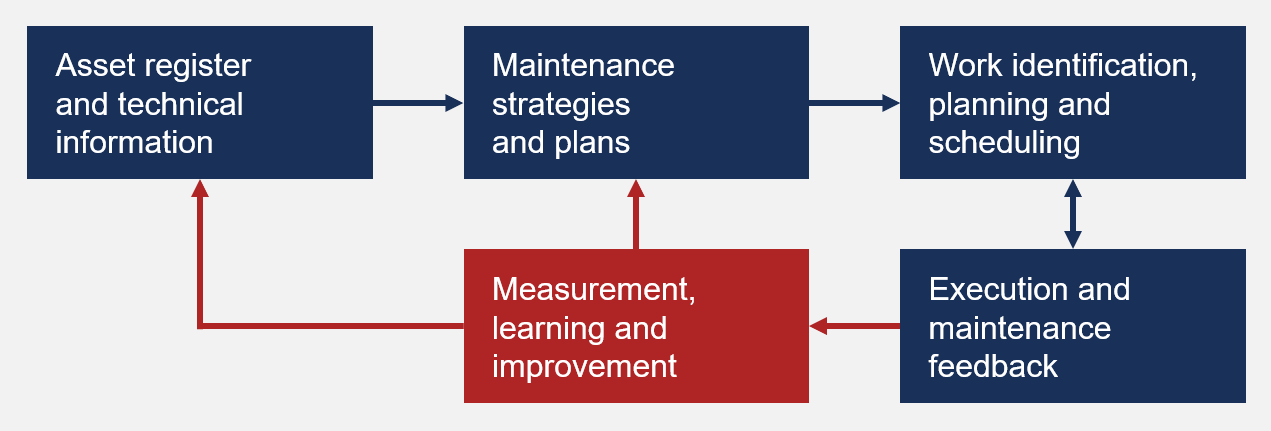
Asset registers and technical information
Engineering drawings, equipment manuals, datasheets and existing spreadsheets often contain the information needed to develop an asset register. Extracting and structuring this information is labour-intensive, especially in environments with large capital projects or extensive asset modifications.
AI can assist by:
- extracting equipment information from technical documents such as manuals and piping and instrumentation diagrams (P&IDs);
- preparing draft asset hierarchies;
- populating standard data fields;
- comparing source documents with existing asset records;
- identifying missing or inconsistent information.
Some of the applications in this domain include 3D scanning and P&ID redlining using a combination of hardware and AI models.
However, AI requires a target structure. The organisation must define its asset hierarchy, functional-location standard, naming conventions, equipment classes and minimum required fields. Without those standards, AI may accelerate the creation of inconsistent data.
The output should therefore be treated as a prepared draft or exception report. A responsible person must still validate and approve the asset baseline.
Maintenance strategies and plans
Developing maintenance strategies for asset types and assets at scale takes a long time. Often, organisations take a pragmatic approach and focus failure modes, effects and criticality analysis (FMECA) on critical assets only, using OEM manuals as input for less critical assets. AI can help review large quantities of equipment information and prepare maintenance content.
Potential applications include:
- extracting recommendations from OEM manuals;
- preparing draft maintenance tasks;
- comparing plans for similar assets;
- identifying duplicates or gaps;
- preparing draft spare parts bills of material;
- checking existing plans against controlled standards.
The quality of the result depends on the quality of the source material. An OEM recommendation or even public internet information may not reflect the operating environment. A historical maintenance plan may contain unnecessary work. An old tactic library may reproduce decisions that were never technically justified. Asset criticality, operating context, failure modes and approved maintenance templates remain necessary.
Much is said about Predictive Maintenance made possible by AI-supported technology and machine learning. In the absence of proper work planning and control processes, predictive maintenance will make little difference: it will generate signals without action. Where the P-F interval (the time between detecting a potential failure and functional failure) is short, the organisation will not have time to react, and AI will provide signals that do not improve equipment availability.
AI can prepare a proposal. Reliability judgement must determine whether the proposed task is appropriate, what interval should apply and what level of risk the business should accept.
Work identification, planning and scheduling
Planning and scheduling involve repeated information checks and prioritisation decisions. AI can potentially assist with:
- classifying work requests;
- identifying duplicate requests;
- checking job readiness;
- identifying missing labour, material or technical information;
- supporting backlog prioritisation;
- highlighting scheduling constraints;
- preparing possible schedule scenarios through auto allocation.
These applications depend on disciplined work-management data. Status definitions must be applied consistently. Planned and reactive work must be distinguished. Work durations must be realistic and available. Resource and material information must reflect operational conditions.
A better recommendation does not create more capacity. It also does not resolve the trade-off between production, maintenance, safety, cost and resource availability. AI can assist a planner, but it does not remove the requirement for planning and scheduling in a maintenance organisation.
Someone must still make that trade-off and accept responsibility for the decision. Organisations must define the framework and boundaries for automated actions upfront.
Execution and maintenance feedback
Execution feedback is an important step in creating maintenance data used to derive information for decision-making. Organisations focus on applications that make it as easy as possible for technicians to provide work feedback.
AI can assist by:
- structuring technician notes into listed text;
- identifying incomplete work-order feedback;
- suggesting failure classification issues;
- converting voice or free text into a draft structured record;
- identifying recurring observations;
- summarising possible failure patterns for technical review.
However, these applications require meaningful failure codes, minimum close-out requirements, usable field tools and sufficient time for technicians to provide feedback.
Technicians also need to see that the information is used. If detailed feedback disappears into the CMMS without visible action, data quality will deteriorate.
If the work order history only says “fixed”, there is little basis for determining why the asset failed, whether the maintenance plan was effective or whether the same failure is recurring. Often here the human in the loop is the weakest part of the information chain. Information in the head of the technician cannot be accessed by AI.
The quality of tomorrow’s AI insight is being determined by today’s work order feedback.
Measurement, learning and improvement
The feedback analysis action is the most important, yet most neglected part of the maintenance information chain.
AI can support the analysis of maintenance performance by:
- monitoring selected indicators;
- identifying trends and anomalies;
- summarising backlog health;
- highlighting recurring failure themes;
- preparing maintenance review information;
- tracking improvement actions;
- comparing performance across assets or periods.
The challenge is not only producing insight. It is ensuring that the organisation can absorb and act on it.
A small set of consistently defined measures is often more useful than a large dashboard. The organisation also needs thresholds, review forums, named owners and authority to implement changes.
Otherwise, AI may increase the number of observations without increasing the organisation’s capacity to improve.
An insight becomes valuable only when it changes a decision, and the result is measured.
Start with a maintenance decision, not an AI model
A practical AI initiative should start with a specific maintenance decision.
Examples might include:
- identifying repeated failures;
- checking work order readiness;
- reviewing a maintenance frequency;
- completing missing asset information;
- improving work-order feedback;
- identifying maintenance-plan inconsistencies.
The organisation can then ask:
- What information is required to support this decision?
- Where is that information currently stored?
- Is it reliable and sufficiently structured?
- Who owns the review and decision?
- What action could follow?
- How will the effect be measured?
AI can then be applied where it reduces the effort involved in extracting, structuring, preparing, comparing or summarising the relevant information.
This creates a controlled use case with a defined decision, responsible owner and measurable result.
From more AI to better maintenance decisions
The organisations that gain value from AI will not necessarily be those with the most algorithms, data platforms or experiments.
They will be the organisations that connect technology, data, processes and people around better maintenance decisions.
The CMMS remains central because it provides the operational context and the maintenance record. AI can help interpret that record, identify patterns and prepare recommendations. Asset care processes convert those recommendations into controlled decisions. People provide technical judgement and accountability. The CMMS then records whether the resulting action worked.
That is the maintenance improvement loop.
AI can make the loop faster. It can reduce manual work and make information more accessible. It can help maintenance teams see patterns that would otherwise remain hidden. But AI cannot close the loop on its own.
Five questions to take back to your organisation
- Which maintenance decision do we want AI to improve?
- What information would AI need to support that decision?
- Is the information reliable and structured enough?
- Who has the authority to act on the resulting insight?
- How will we know whether the action improved asset performance?