Author | Nelson Broden – Business Lead Pragma Managed Services
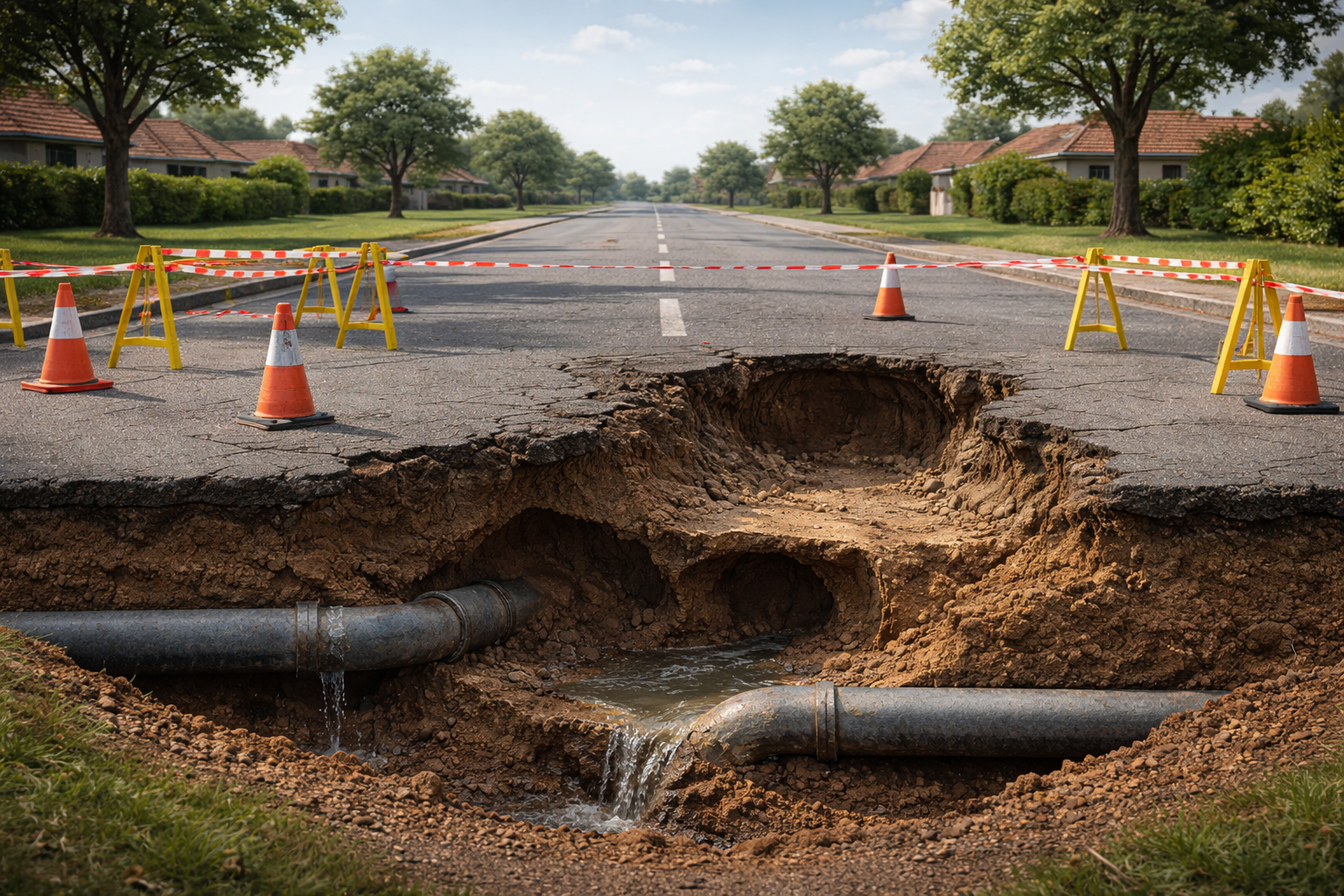
On the school run through Lyttelton, Centurion, commuters have become used to checking three things every morning: the traffic, the weather, and whether the road is still there. Detours around sinkholes have become so routine that people barely react anymore. What should be shocking has been normalised — even as the ground beneath our tyres and homes continues to shift.
Sinkholes, collapsing pavements and sudden road failures are not random geological surprises. They are symptoms of something deeper: a water infrastructure system deteriorating below the surface, quietly weakening the structures our cities depend on.
South Africa’s water narrative is usually about shortages and treatment failures. But an equally urgent crisis is unfolding underground. Ageing pipes, leaking connections, blocked stormwater systems and neglected sewage lines are steadily eroding roads, buildings, walkways and bridges. The result is a slow, creeping unravelling of urban stability — one pothole, crack and collapse at a time.
Why are roads, sinkholes and buildings failing?
The damage begins quietly.
Roads: The invisible rivers beneath the asphalt
Most people blame potholes on rain or traffic. Engineers know the real culprit is often water moving through the layers beneath the road. Leaking pipes and blocked drains saturate the subgrade that carries the load. Heavy vehicles then “pump” water and fine material through cracks, turning small defects into major failures. When stormwater systems can’t cope, roads effectively become rivers, eroding their edges and washing away the structure beneath.
What looks like a simple pothole is often the final stage of a long, unseen excavation.
Sinkholes: When a drip becomes a collapse
Dolomitic regions such as Centurion, Carletonville and parts of Johannesburg face a particular risk. Dolomite dissolves in water. A single leaking pipe or poorly directed stormwater flow can channel water into fractures, slowly enlarging underground cavities.
This is why so many sinkholes follow pipe bursts or long-term leaks. The water doesn’t just wet the soil — it carries it away.
Engineering geologists have warned for years: these sinkholes are not “acts of God”. They are predictable outcomes of water mismanagement on fragile geology. Every unnoticed leak becomes a small drilling machine operating beneath our suburbs.
Bridges, buildings and foundations losing stability
Water does not stop at roads. Fast-moving stormwater can scour soil from around bridge foundations, undermining structural stability. Escaping water from ageing mains weakens the ground beneath homes, schools and commercial buildings. Foundations settle unevenly, cracks appear, and in extreme cases, the ground gives way.
Flood events accelerate this process. Urban areas covered in hard surfaces rely on drainage systems that are often undersized or poorly maintained. When these systems fail, water spreads laterally, eroding embankments and destabilising pavements long after the rain has passed.
It is not a natural disaster – it’s an asset management issue
The equation is simple: Water + time + neglect = collapse.
None of these failures are inevitable. Countries with similar geology and rainfall patterns manage these risks through disciplined asset management — routine inspections, leak detection, predictive maintenance and systematic reinvestment in ageing infrastructure.
When water systems are treated as interconnected assets rather than isolated repair jobs, failures become predictable and preventable. The challenge is not a lack of engineering knowledge; it is a lack of structured, consistent execution.
A collaborative path forward for municipalities and industry
South Africa needs a fundamental shift in how it manages water systems below the surface. The places where the ground is giving way today are the warnings for where it will fail tomorrow.
Key priorities include leak detection programmes, updated stormwater planning, predictive maintenance on high-risk pipes, routine scour assessments on bridges and accurate, integrated asset registers. Community reporting channels can also become powerful early-warning systems.
Every delayed repair is a future collapse in the making. Every small leak becomes a future sinkhole.
A ground that holds — or a ground that gives way
What is happening in Centurion is not isolated. It reflects a broader national pattern of infrastructure weakened by unmanaged water. If we want roads that last, bridges that stand and buildings that remain stable, we must treat water infrastructure as the critical asset network it is.
Because when water is unmanaged, the ground does not just soften — it gives way.